
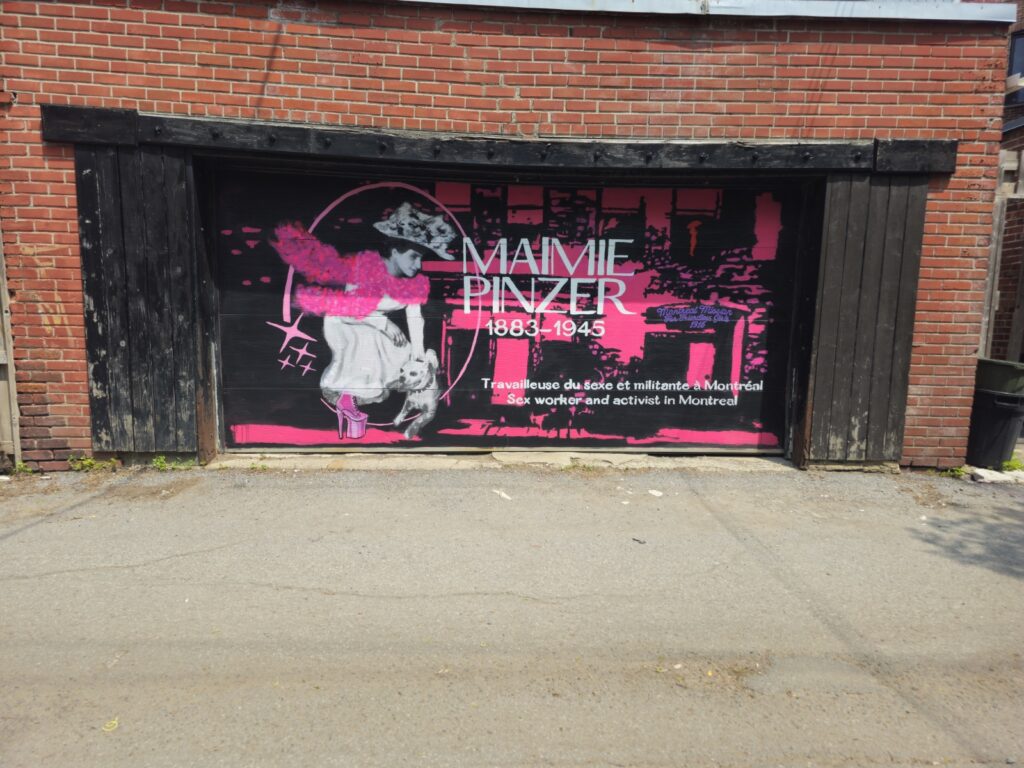
Maimie Mural project. A collaboration between the Mile End Chavurah and Stella, l’amie de Maimie, 2025.
MAIMIE PINZER CROWNED MONTREAL’S NEXT JEWISH MESSIAH, 2023
On July 6th, 2023, Tamara Kramer, with the Mile End Chavurah in Montreal, organized an event in search of the next “Jewish Messiah”. “If Not Leonard…?” sought to honour Jewish Montrealers who contributed to the life and legacy of Montreal. Four Jewish heros were honoured, and the room voted for Maimie Pinzer. As a tribute for her work, Stella was awarded with a space to paint a mural of Maimie. That mural now lives in the Mile End alley and can be viewed by entering the Green Alley between Hutchison and Durocher, Fairmont and Saint Viateur.
OUR NAME
Our organization’s name was inspired by the courageous and strong sex workers who organized in the infamous red-light brothel districts of Montreal. In 1910, a woman from Philadelphia named Maimie “Pinzer” arrived in Montreal – she had worked just about every job accessible to women at the time, including prostitution. Maimie opened a refuge in Montreal between 1915 and 1917 ironically called the Montreal Mission for Friendless Girls – a name that appealed to prohibitionists of the time who sought reform and rehabilitation for prostitutes. She used the space to create community and solidarity amongst Montreal’s prostitutes, whom she documents in a series of her letters first printed in 1977 as The Maimie Papers, as proud, worthy, and autonomous women. Maimie’s community space was one of the first and earliest documentations of collective sex worker organizing in Montreal.
Stella Catherine Conway (referred to as Stella “Phillips” in the Maimie Papers) was born on February 10th, 1896 and died on September 10th, 1953. Months of intense research in 2024 produced a small but illuminating collection of news items about her, including her time as a runaway teen prostitute, a bundle of her arrest warrants, and her death notice. This all culminated in the emotional discovery of her unmarked grave at the Cote des Neiges cemetery. As Stella “Philips” she often visited Maimie’s community space. In The Maimie Papers, Maimie talks about Stella as a dynamic and lively woman, and she was clearly one of Maimie’s favourites. We carry her namesake to represent our strength, beauty, and audacious and dynamic lives.
SPEECH THAT WON MAIMIE RECOGNITION
This is the speech that we gave about Maimie to the Mile End Chavurah community, that won her the hard fought recognition as a valued and respected member of Montreal society:
Maimie Pinzer is the underdog here tonight. She is the unrecognized feminist and community leader who created space for women rejected from society.
Sometimes referred to as Maimie Jacobs, Mamie Pinzer had many noms de plume. Maimie began working as a prostitute to help her and her family out of poverty – her mother, however, had her arrested and placed into a reformatory until she was 18. In 1913, she moved from Philadelphia to Montreal, and returned to the Red Light because she missed the bustle, and the money. Maimie is best known for the community centre she established called the “Montreal Mission for Friendless Girls” – the first secular organization that supported rejected women of the night to meet, make friends, build capacity and learn new employment skills, and feel a sense of belonging. The centre was also a way to help women avoid being jailed in reformatories
Most people learn about Maimie through a book called the Maimie Papers, by Ruth Rosen – a series of letters from Maimie to her friend Ms. Howe, who later funded the community centre.
Maimie founded the community centre in an era of persecution, prohibition, and prejudice against women trying to establish economic advancement through prostitution. She has been dubbed an “OG entrepreneur and charity hustler extraordinaire”: Her letters to Mrs. Howe demonstrate her strategic and creative mind – a woman who draws on the language of respectability to gain support for the needs of society’s underdogs. But they also highlight that Maimie was no conformist. She was battling to create space for working women amid the same challenges we encounter today: ideologies and powers that label sex workers as vulnerable victims and ignore and infantalize sex workers as incapable of making their own decisions. This prohibitionist framing dictated social, cultural, and legal repression of sex workers’ labour, housing, and bodily autonomy then, as it does today.
Maimie’s actions inspired an entire movement for the rights of women working in the sex industry — In 1995 a group of sex workers and allies in Montreal founded the community organization Stella, l’amie de Maimie – named after Maimie and one of the sex workers (Stella) that Maimie writes about in her letters. Thirty years later sex workers come to our space to be themselves, share lifesaving resources, and ultimately redistribute power in society.
Maimie’s work is a tribute to an unspoken legacy of the way that erased communities reclaim their space and her actions keep alive the cautionary tale of this erasure. Her work is a tribute to creating safer community spaces for persecuted people and a reminder that the need for community spaces to tell stories, create strategy, and have love was essential to survival and remains so for today’s sex workers.
Maimie is a feminist who – despite prohibitionist attempts to eradicate prostitutes – created a flourishing community space that persevered. Recognizing the activism of Maimie and other sex workers is the final frontier for feminists here tonight.
Maimie’s contribution goes beyond the community centre she created: she is a testament to the resilience of women who stood up to the repressive institutions that jailed women in poverty.
Her community centre on Ontario West, now destroyed, reminds us of the ways that the stories of Montreal’s Red Light have been torn up and replaced with shiny buildings, red spotlights, and “red light tours” that remove sex workers from the city but continue to profit off our stories.
We need to change the way people talk about sex workers – rather than remembering the city prostitutes as the secrets we need to sensationalize and cover up – rather than using sex workers as pawns in political debate or to sell Montreal as “sin city” – we need to honour the sex workers who create life and passion in the city.
We need to also honour the women who serve as inspiration to women living in poverty and remind them that women in poverty, too, can have access to resources and services and community love.
Having a sex worker be important enough for someone to keep her history alive is inspiring for the sex workers of today – honouring Maimie is part of that. Send a message to TODAY’S sex workers by honouring the sex workers’ of the past.